

With such a scattered, remote geography, it’s no surprise the Seychelles has become a genuine sanctuary for wildlife found nowhere else on Earth. The islands are home to over 1,000 flowering plant species and more than 220 bird species, alongside a striking cast of insects, amphibians and reptiles — including the world’s smallest frog and its largest land tortoise.
What’s really impressive is how deliberately this has been protected. Conservation sits at the heart of almost every development decision here, old or new, which is part of why the Seychelles holds onto more thriving indigenous species than any other inhabited island group on the planet.
Praslin: Palms, parrots and the Coco de Mer
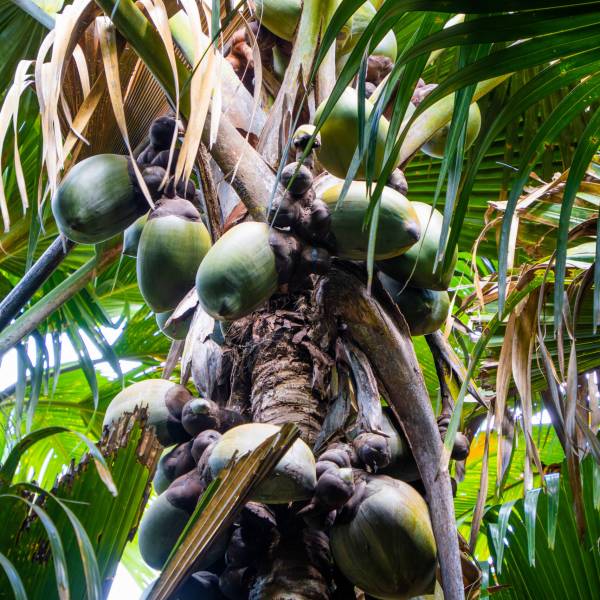
Praslin is where most botanists point you first, thanks to the Vallée de Mai Nature Reserve at its centre. This UNESCO World Heritage Site is one of the smallest natural sites on the entire UNESCO list, yet it’s the only place on Earth (alongside neighbouring Curieuse) where the famous coco de mer grows wild – the palm behind the world’s largest seed, wrapped in centuries of local folklore. The reserve is also the meeting point for all six of the Seychelles’ endemic palm species, a combination found nowhere else.
Look up while you’re walking the reserve trails and, with luck, you’ll spot the rare Seychelles black parrot, the national bird, found nowhere else in the world and currently listed as vulnerable, with an estimated wild population in the low hundreds.
Mahé: Jellyfish trees and carnivorous plants
The main island isn’t just where you’ll land – Mahé’s forests, particularly within Morne Seychellois National Park, hide some of the archipelago’s strangest plant life. The jellyfish tree is found nowhere else on Earth and was once thought extinct until a handful of surviving trees were rediscovered in the 1970s; its odd, upside-down-jellyfish-shaped seed pods give it its name, and it remains critically endangered. Higher up in Mahé’s granite peaks (and in Silhouette’s forests too) grows the Seychelles pitcher plant, the archipelago’s only carnivorous species, its curling leaf forms a nectar-rimmed pitcher that traps and digests unwary insects. Keep an eye out too for the wild vanilla orchid, prized for its striking salmon-pink blossom, though its fruit – unlike true vanilla – isn’t edible.
Silhouette Island: Cloud forest and coastal trails
Silhouette is the other must-visit for plant life, with an extraordinary 93% of the island protected as national park and often described as the “Aldabra of the granitic Seychelles” for its untouched habitats. Towering cloud forest canopies give way to coastal forest lower down, laced with trails that let you move through several distinct ecosystems in a single walk – and, at altitude, you’ll find the same rare pitcher plant that grows on Mahé.
Cousin Island: A seabird and turtle stronghold
Just off Praslin, Cousin is arguably the single best place in the Seychelles to see wildlife concentrated in one spot. Five of the country’s eleven endemic land bird species live here, including the Seychelles fody, Seychelles magpie robin, Seychelles sunbird and Seychelles blue pigeon, alongside seven species of nesting seabird. It’s also the most important hawksbill turtle nesting site in the whole western Indian Ocean, with a turtle monitoring programme running continuously since 1970 – a genuine conservation success story you can witness first hand on a guided tour.
Indigenous birds worth watching for
Beyond the species above, keep an eye out for the Seychelles kestrel – the smallest kestrel species in the world, and another conservation good-news story after recovering from near extinction.
Beyond the birds: reptiles, amphibians and giants
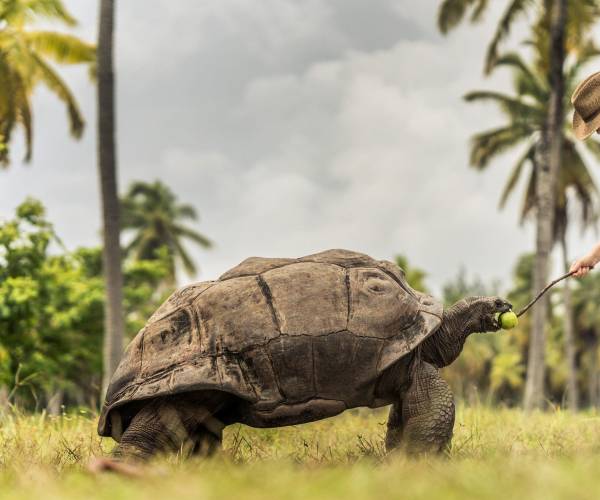
The Seychelles’ reptile and amphibian life is just as distinctive. Alongside the Aldabra giant tortoise – the world’s largest land tortoise species, native to remote Aldabra Atoll and now also thriving in protected reserves like Denis Island – the islands are home to Sooglossus sechellensis, one of the smallest frogs on Earth, tucked away in the damp forest floors of Praslin and Silhouette.
Look closer and you’ll also find endemic bronze geckos, Seychelles tiger chameleons, day geckos and several species of skink, many found only within protected habitats like Vallée de Mai and Aride.
A delicate balance, carefully maintained
None of this happens by accident. The Seychelles has built tourism around conservation rather than in spite of it – from strict visitor limits on reserves like Cousin, to decades-long species monitoring programmes, to entire islands like Silhouette being set aside almost in their entirety for nature. It’s this balance that makes the Seychelles one of the very few places left where you can still see this much thriving, untouched biodiversity in the wild – flora and fauna both – spread across a whole cluster of islands, each with its own specialities worth building into your itinerary.
